How LEGO® Education Enables Model-Based Science Teaching
Model-based science teaching is widely recognized as a core practice of effective science instruction. Yet in many classrooms, modeling remains an underutilized practice. Constraints around planning time, materials, assessment clarity, and relevant professional development often make it feel unsustainable and difficult to approach.
In this article, we’ll touch on the meaning and power of model-based science teaching, dive deeper into common challenges, and show how LEGO Education can help teachers overcome obstacles to make modeling a more available and sustainable classroom practice.
A Quick Refresher on Science Modeling
A model is a simple representation of a complex system or idea—and it’s an essential skill in science. Often, without realizing it, learners already use them in their everyday lives. Whether playing, drawing, or building, models help children turn abstract theories into concrete ideas.
In the classroom, teachers use models to bring concepts or phenomena to life so students can see how ideas work in real-world contexts. Effective scientific models encourage students to question and critically evaluate their understanding of a concept, offering opportunities to test their theories, collect evidence, and adjust their thinking to find new solutions. This ongoing process of reviewing and retesting ideas based on evidence helps students deepen their understanding and refine their knowledge.
Why is Modeling Critical for K-8 Science?
Many science concepts introduced in elementary and middle school are inherently complex and often invisible. Students are asked to reason about forces they cannot see, particles they cannot observe, or systems that operate beyond direct experience. Even the concept of science learning itself can be abstract when students think of it in the context of memorizing and recalling facts rather than developing a mental framework for making sense of the world through evidence and explanation.
Modeling is critical for this age group because it addresses both challenges – it’s a practical way to make the abstract tangible and to start ingraining the practice of scientific thinking as a foundation for deeper learning in later grades and for problem-solving beyond the classroom.
What’s more, it’s a way of learning that aligns with how children and young teens naturally make meaning of the world around them. Young learners routinely use objects in play as stand-ins for larger ideas - blocks become buildings, drawings represent imagined worlds, simple materials stand in for complex systems. Modeling leverages this instinct and can make learning more accessible.
Here are a few additional benefits of science modeling in the classroom
- Modeling plays a central role in many science standards such as Next Generation Science Standards (NGSS), where “developing and using models” is one of the eight Science and Engineering Practices. It helps students engage with their learning so they can explain phenomena and test ideas through active sense-making rather than passive learning.
- Observing students as they develop and build models provides educators with a genuine way to assess and gain insight into a learner's growing skills and understanding, beyond what is possible through multiple-choice tests.
- Modeling is an effective approach for diverse classrooms. It makes learning explicit, inclusive, and hands-on, meeting students where they are and helping all learners understand not just what to do, but also why and how to do it.
How Does LEGO Education Facilitate Modeling in the Classroom?
The biggest challenge in overcoming modeling barriers are the institutional constraints that teachers cannot easily change. For modeling to become a feasible and consistent part of science learning, it must fit naturally within existing constraints rather than compete with them. LEGO® Education Science is built with that integration in mind.
Let’s review some of these common constraints and look at how LEGO Education Science breaks those barriers down
Excessive Prep → Streamlined Implementation
Model-based lessons can feel time-intensive to prepare, especially when teachers must source materials, design build experiences, and align everything to instructional goals. When planning time is limited, these added steps can make modeling difficult to sustain.
LEGO® Education Science reduces that preparation burden. Each kit includes reusable materials and ready-to-teach lessons designed for efficient setup and consistent classroom use. Rather than assembling resources independently, teachers can focus on facilitating learning from the outset.
Static Models → Buildable and Iterative Learning
In many classrooms, models are pre-made or demonstration based. While useful for illustration, static representations limit student interaction and reduce opportunities for testing and revision which is an essential part of scientific thinking.
LEGO® Education Science centers learning around student-built, collaborative models. Lessons begin with guided construction and transition into testing, modification, and exploration. Students actively refine their models, reinforcing understanding through iteration rather than observation alone.
Assessment Uncertainty → Standards-Aligned Measurement
Assessing model-based work can present challenges when criteria are unclear or difficult to align with academic standards. Without defined evaluation structures, teachers may hesitate to integrate modeling regularly.
LEGO® Education Science includes standards-aligned lessons and embedded assessment rubrics with defined criteria. This structure supports transparent evaluation and ensures model-based learning connects directly to required learning outcomes.
Limited Training → Confident Facilitation
Without targeted professional development, teachers may feel uncertain about how to guide model-based inquiry effectively. Even with strong materials, low confidence in utilizing a model-based approach can contribute to hesitation in pursing it.
LEGO® Education Science supports teacher growth through structured professional development designed around hands-on, student-centered instruction. Facilitated workshops, coaching opportunities, and competency-based learning experiences help educators build practical strategies for leading modeling lessons with clarity and confidence, making implementation more sustainable over time.
LEGO Education Science – Modeling Applications in Practice
Let’s look at how modeling in LEGO Education’s science lessons strengthens classroom instruction.
Models Help Communicate Understanding
Models help students communicate their understanding of lesson content. They provide tangible representations of learning that can be revised and refined as students’ understanding deepens.
Lesson Example: Ra-Ra-Rattlesnake
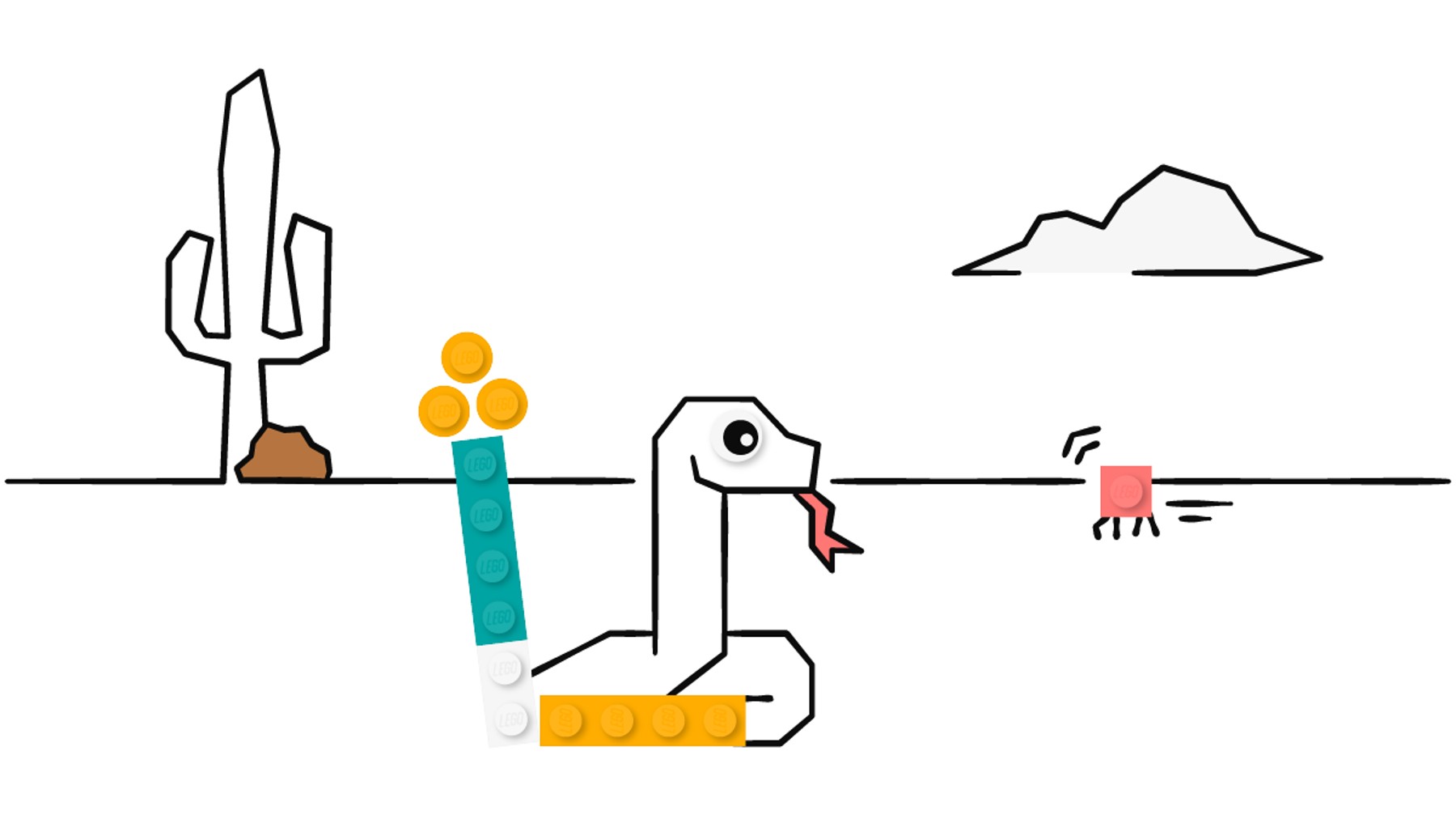
In ‘Ra-Ra-Rattlesnake,’ students learn how certain animals have evolved to survive in their environments. Using a snake as an example, they build a model with a rattling tail and venomous fangs. Students discuss how these structures help rattlesnakes survive, then brainstorm other animals with structures that aid in their survival.
At the end of the lesson, students build their own models, transferring their new rattlesnake knowledge about external structures from the initial rattlesnake into a design they can use to demonstrate their learning.
Models Help Teachers Correct Misconceptions
Children develop mental models to help them make sense of the world around them. However, these models are often incomplete or underdeveloped, which can lead to misconceptions (or alternative conceptions). But when learners create conceptual models, they can update or fill gaps in their mental models and correct misconceptions.
Lesson Example: What the Sun Sees
In the LEGO Education lesson ‘What the Sun Sees’ students build a model of the sun and the Earth, with a gardener standing on the Earth. The sun appears with a hole through the middle, so students can see the Earth from the sun's perspective. Students rotate the model and look through the sun. When they can see the gardener on the earth, it is daytime; when they cannot, it is nighttime for the gardener.
Many students believe that the sun’s movement causes night and day because they see it rise and set in the sky. This lesson shows them that it’s the Earth's movement, rather than the sun’s, that causes this phenomenon, helping them complete their mental model and correct their misconception.

Models Go Beyond What Can Be Observed
Conceptual models help students envision a world beyond their own reality, making learning more equitable. By building a model of a complex system or phenomenon that can be manipulated and studied, students can begin to envision concepts that are otherwise out of reach.
Lesson Example: Protect Baby Elephant
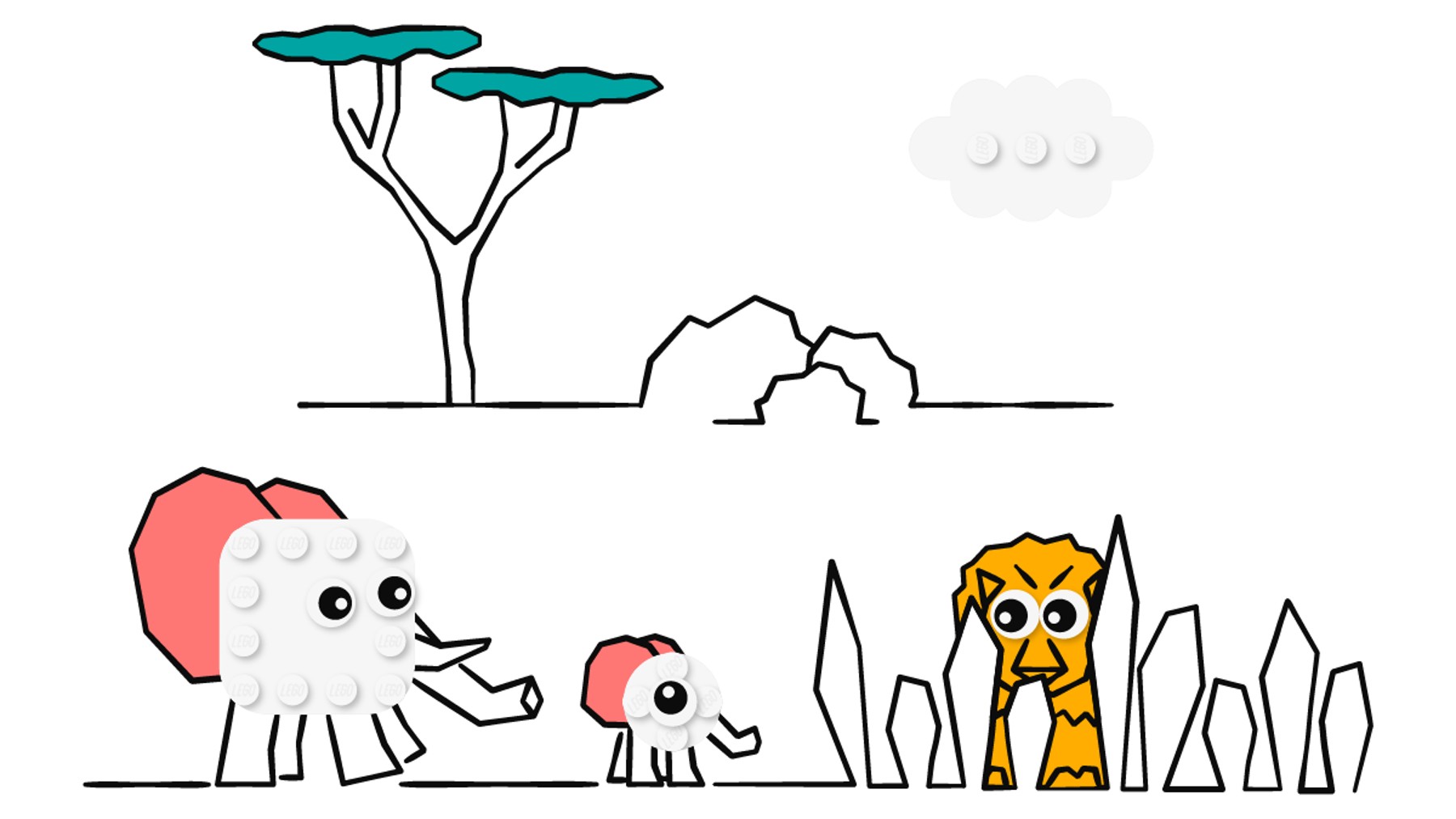
‘Protect Baby Elephant’ teaches learners how animals living in groups have a better chance of survival. Students build an elephant calf, a mother elephant and a lion. Then, using the model's built-in hardware, they try to help the mother elephant protect her calf when the lion attacks. Alone, the mother elephant is unsuccessful.
When revising their model, students can explore how a herd of elephants might help. They add as many as they want to the turning mechanism, creating a protective circle around the calf.
This model represents a phenomenon that exists in the real world. It helps students understand why animals are more likely to survive when they live in groups by connecting what they already know to a world they can’t experience firsthand.
Model-based science teaching should not feel like an added burden. When materials, instruction, assessment, and professional learning are aligned, modeling becomes a sustainable and impactful classroom practice. Explore how LEGO® Education Science supports teachers in making hands-on, model-based learning a consistent part of everyday instruction.
About the Author
Dr. Colleen Cannon-Ruffo is a Solution Architect for LEGO® Education, partnering with district leaders and account managers to ensure that LEGO Education solutions align with instructional goals and that teachers feel confident implementing them. With more than 20 years of firsthand experience using LEGO Education solutions in her own work, she brings both practical classroom insight and deep technical expertise to districts seeking to elevate STEM and Computer Science instruction. She holds a Master’s degree and a Doctorate in Instructional Technology and is passionate about ensuring all students have access to engaging, hands-on learning. Before joining LEGO Education, she spent 29 years in Illinois public schools as a classroom teacher, Technology Integration Specialist, and district-level Project Manager.
Follow Colleen on LinkedIn