How SBCUSD Uses LEGO® Education to Drive Equity, Engagement, and Standards Mastery
- District: San Bernardino City Unified School District (SBCUSD)
- Location: San Bernardino, California
- Size: ~44,000 students across 74 schools
- Community: Title I district; ~90% socioeconomically disadvantaged, ~21% English learners
- Featured Solution: LEGO® Education SPIKE™ Essential
- Academic Growth: Pilot schools saw average growth of approximately 25% in both math and ELA, according to NWEA data.
- Equitable Access: Every participating school has dedicated STEAM staff, ensuring every student has access to the same experience.
- Rapid Expansion: The program added 12 new schools last year and another 12 this year, with principals currently on a waitlist.
- Student Transformation: Nonverbal special education students are meeting IEP goals, while previously disengaged students are emerging as creative leaders.
The Challenge: Closing the Early STEAM Equity Gap
San Bernardino City Unified School District (SBCUSD) had built strong college and career pathways at the secondary level, but leaders noticed a critical gap: students were entering those pathways without prior STEAM experience or exposure. Compounding that, STEAM access across the district was inconsistent, often dependent on whether an individual teacher or principal happened to champion it.
The district needed a systematic, scalable, and equitable approach to STEAM, one that would reach every student, regardless of grade level, language, school site, or academic background.
Recognizing the potential for innovative tools, SBCUSD turned to LEGO® Education as a key component to engage students early in STEAM learning.
The Vision: SBCUSD SHINES and a New STEAM Department
The district launched SBCUSD SHINES, a 2030 vision built with input from community members, board members, teachers, and students. The "H" in SHINES stands for High Expectations for Academics and Innovation to be College and/or Career Ready, which explicitly calls out that "STEAM, robotics, and computer science are implemented at all grade levels and embedded within district curriculum."
To bring that vision to life, the district launched a dedicated STEAM & Innovation Department in 2023. What began as a team of two has rapidly grown to six program specialists supporting TK–8 STEAM experiences across the district. The team operates on a regional cluster model, with each specialist coaching schools in their assigned cluster and collaborating closely with other departments—elementary instruction, multilingual, special education, and educational technology—to ensure every lesson is accessible to every learner.
The growth has been remarkable: from a handful of pilot sites, SBCUSD will offer STEAM programming at all 11 middle schools and 34 of its 50 elementary schools in the upcoming year, with principals on a waitlist to be next.
The Innovative Approach: Standards First, Tools Second
What sets SBCUSD apart is its philosophy: STEAM tools serve to support the standards, not the other way around.
"We are never teaching a tool. We are teaching the standard through the use of a tool," explains Caitlin Arakawa, STEAM & Innovation Program Specialist at SBCUSD. "LEGO Education is one of our innovative tools, but the standard always comes first."
In addition to running LEGO Education SPIKE Essential lessons as-is, Caitlin's team uses the LEGO Education platform as a launchpad for inspiration, designing custom lessons that align tightly to NGSS, math, ELD, and computer science standards while embedding UDL principles and Kagan collaborative conversation structures.
Why LEGO Education Was an Early Priority
LEGO Education materials were one of the first investments for SBCUSD's STEAM labs because they uniquely combine engineering, computer science, and science standards alignment in a single, flexible platform.
"LEGO Education is a privilege that so many of our students don't typically get to experience. It's automatically engaging," Caitlin shares. "It allows for purposeful play. Sometimes school unintentionally limits students' creativity by emphasizing that there's only one right answer. Innovation begins when students realize there can be many possible solutions.”
Inside a Custom Lesson: Meet "Byte" the Robot
To bring lessons to life, the STEAM team created a department mascot, Byte the Robot, who appears in every lesson as a character experiencing real-world phenomena and asking students to help solve his problems.
Example: A Custom Lesson on the Sun's Movement and Shadows
- Anchor Standard (NGSS): Use observations of the sun, moon, and stars to describe patterns that can be predicted.
- Real-World Scenario: Byte wants to find the best shady spot to cool off at school. In the morning, the shade is on the left of the tree. At lunch, there's barely any shade. After school, the shade has moved to the right. Why?
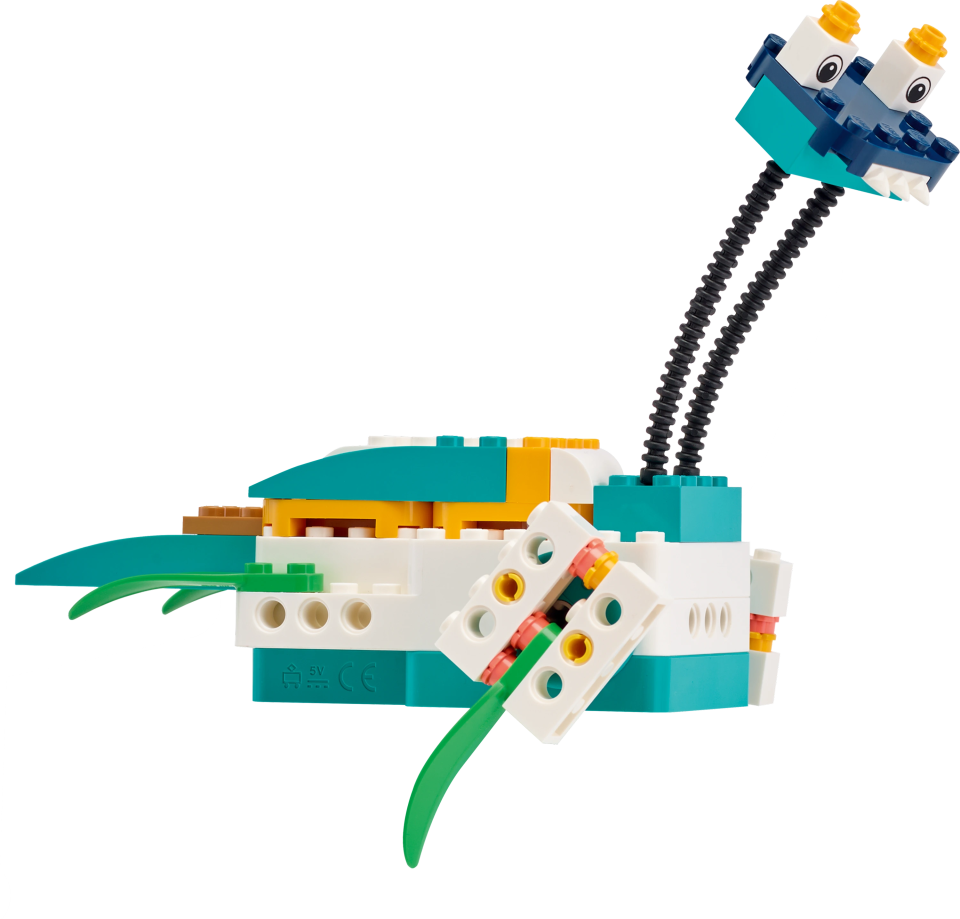
- The Build: Students use LEGO Education SPIKE Essential to design and program a model that helps Byte solve his problem, integrating engineering, coding sequences, and scientific modeling.
- Lesson Structure: Every lesson follows the team's custom LAB instructional model: Launch (activate curiosity through real-world context), Apply (design, problem-solve, and apply learning cross-disciplinarily), and Boost (evaluate, revise, and deepen understanding).
Students, meanwhile, work through the engineering design process—ask, imagine, plan, create, test, and redesign—on their planning sheets.
"What I love is that AI helps us generate comic-book-style images of Byte experiencing these scenarios," Caitlin adds. "When students see Byte at a district event, they say, 'That's the robot from my STEAM lab!' They’re able to connect with the learning experiences."
Scaling Lesson Design Across a Large District
With 8–10 custom units per grade level, the team has built a robust lesson development process:
- The team holds weekly curriculum meetings to align lessons to scope and sequence.
- The team collaborates across departments, including multilingual, special education, and elementary instruction teams, to ensure accessibility.
- Every lesson incorporates key criteria, including a real-world scenario, ELL scaffolds, vocabulary in context, the engineering design process, structured collaborative conversations, and a coding, engineering, or digital design component.
- STEAM teachers have access to a Google Classroom hub with lessons, pacing guides, and resources.
- Teachers receive ongoing coaching and in-classroom observations, along with structured feedback sessions where they rotate through grade-level tables to refine lessons together.
"Sometimes the edits teachers make are so powerful—I'm always asking them to give me that resource! Send me that slide!" Caitlin says. "That collaboration strengthens every lesson by increasing student engagement, improving accessibility, and enhancing teacher facilitation."
The Results: Engagement, Equity, and Measurable Growth
Student Engagement and Transformation
Teachers regularly report seeing new sides of their students in the STEAM lab. "We have nonverbal special education students now asking for help and leading their small groups. That's an IEP goal being met," Caitlin shares. Students who struggle to focus in traditional classrooms often become "laser-focused and creative" in the STEAM lab.
Academic Growth
At the district's eight pilot schools—those with two full years of STEAM programming—NWEA data shows approximately 25% average growth in both math and ELA, even though the STEAM lab takes 50 minutes per week away from core instruction.

Buy-In and Expansion
The program expanded to 12 new schools last year and will reach 12 additional schools this coming year. Demand continues to grow, with principals actively joining a waitlist to bring the program to their schools. The program has also earned strong support from the board, superintendent, and families, helping build momentum for continued expansion.
- Start with a shared vision. Engage families, community, board members, and educators. "Our families are our biggest advocates."
- Invest in dedicated STEAM staff. "Having a dedicated staff member in each lab closes the equity gap. It's not based on which teacher you get or which school you're at, every student gets the same high-quality experience."
- Lead with standards, not tools. "Tools will change. Standards-aligned, real-world, cross-disciplinary learning will not."
- Build for equity from day one. District-level oversight on lesson design, materials procurement, and professional development ensures consistency for every learner.
Looking Ahead
As SBCUSD moves toward its 2030 goal of STEAM at every elementary and middle school, the team is shifting its professional development focus from "hands-on" to "minds-on" learning, ensuring students can articulate the connection between their LEGO Education builds and the standards they're mastering.
"I'm excited to see where we'll be in five years," Caitlin reflects. "When today's kindergartners are sixth graders, they'll have had six years of STEAM. They'll have that muscle to be creative, think independently, and fail forward. That's the future we're building."
Interested in bringing hands-on STEAM to your school or district? Learn more about LEGO Education solutions.